Conditional session statistics for MNQ futures.
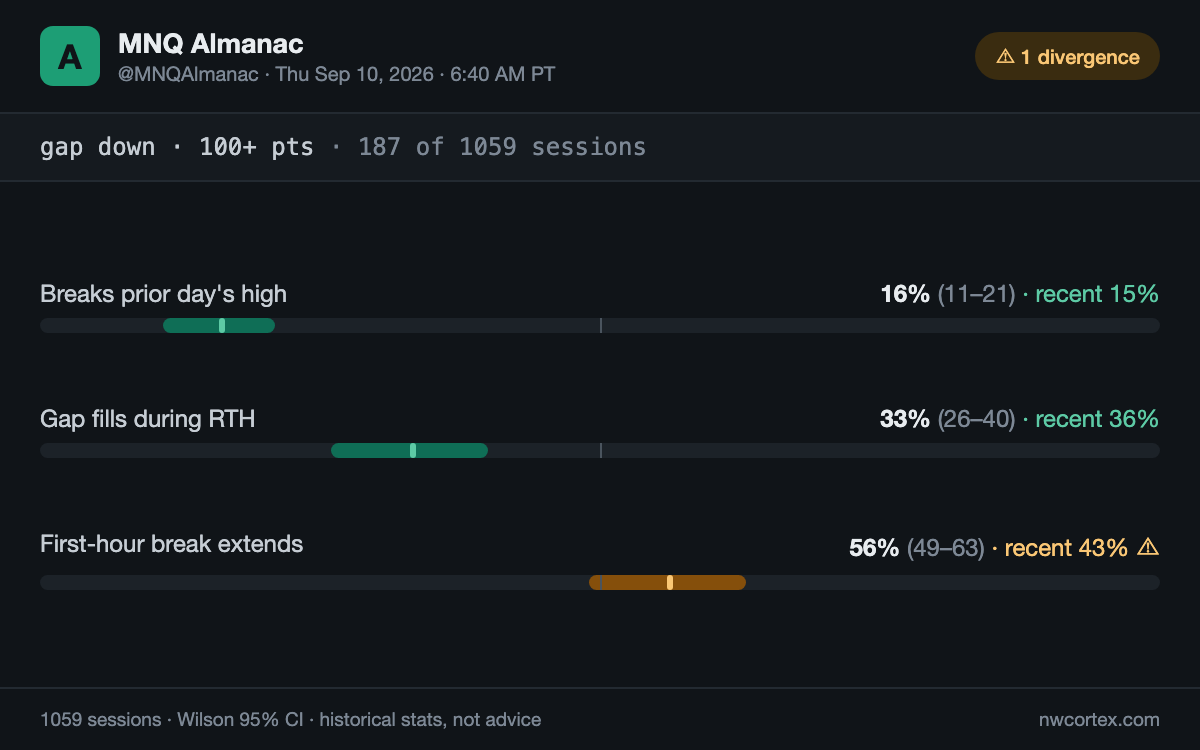
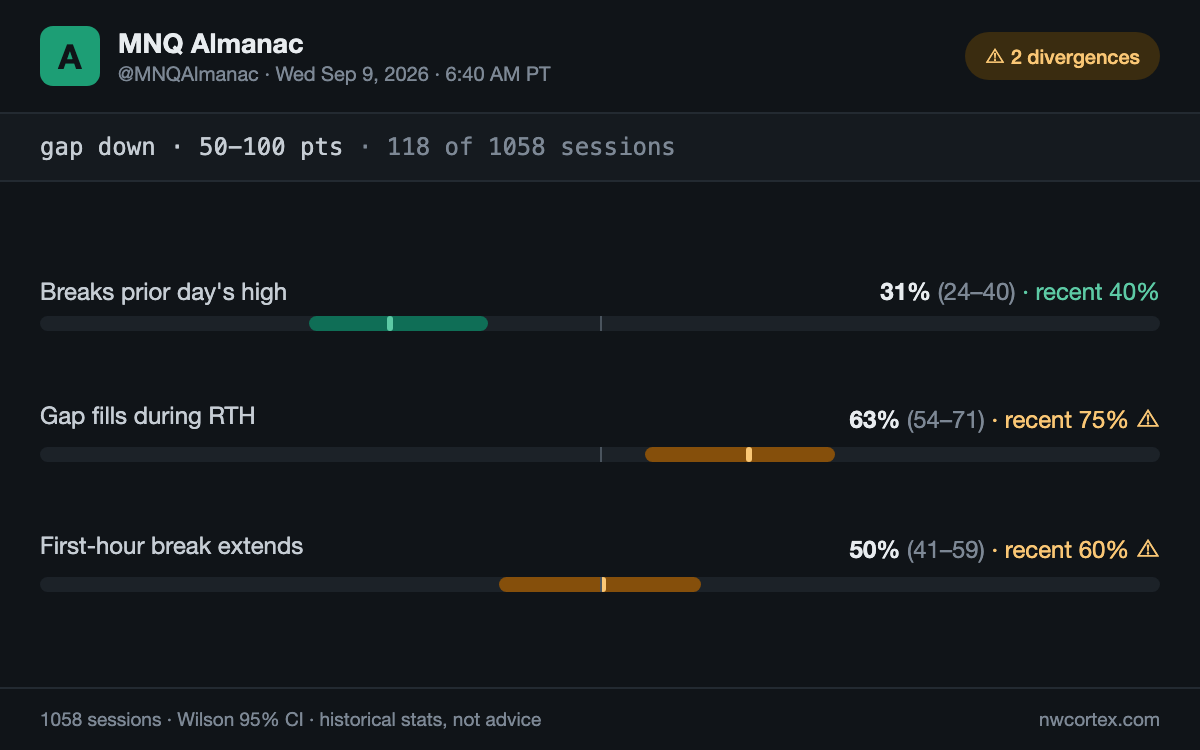
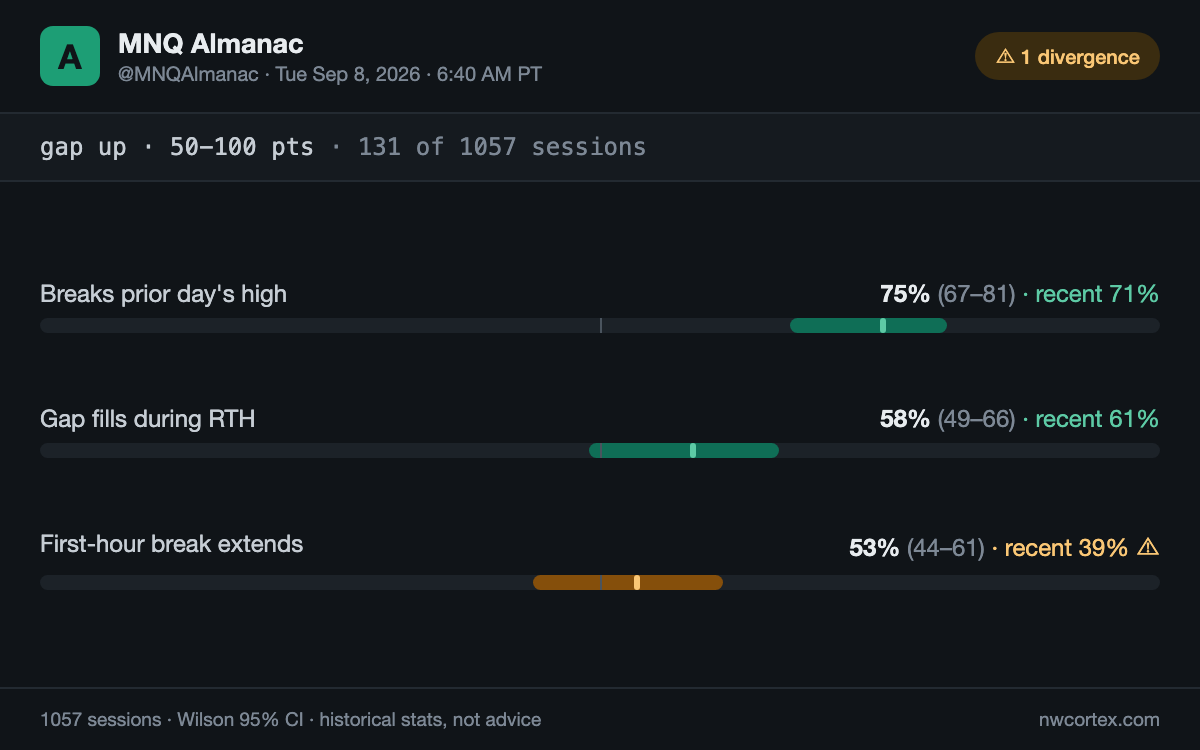
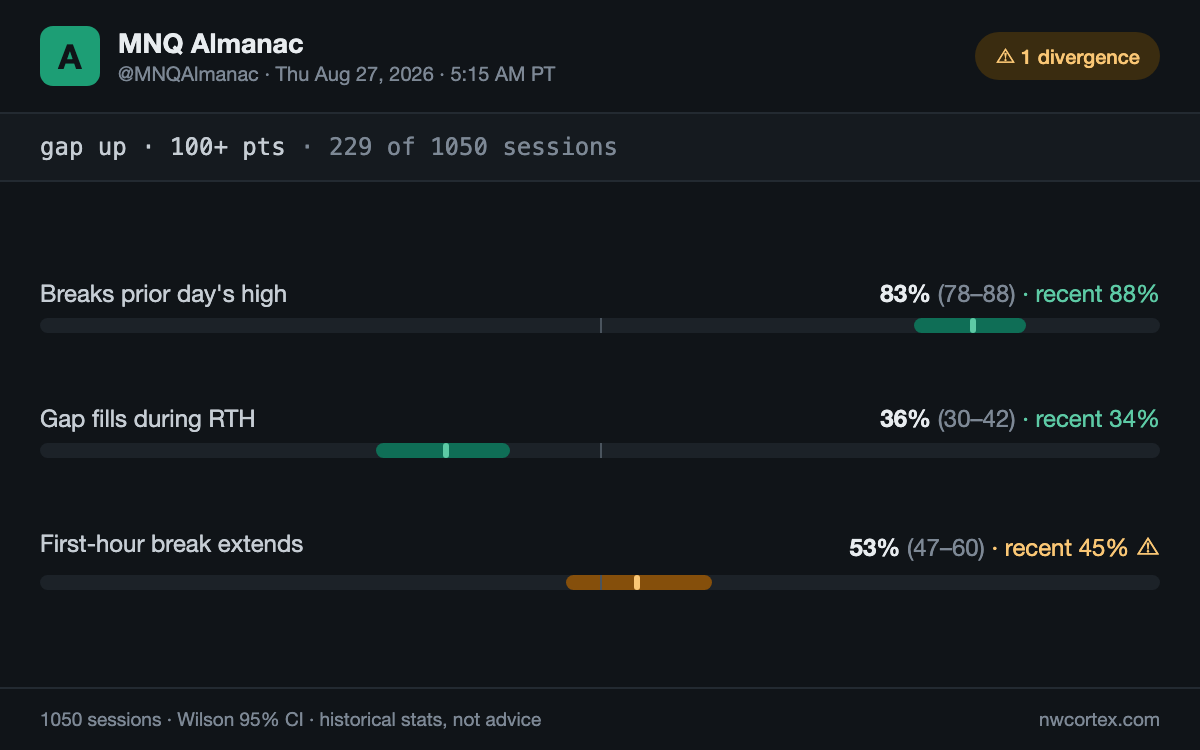
Each card from @MNQAlmanac covers one session: its condition, and what MNQ has historically done under it — computed from 1,000+ sessions with Wilson 95% confidence intervals and divergence flags. Historical statistics, never predictions.
NO TRADE CALLS, NO DMS, NO ADVICE.Every card, dated, unedited
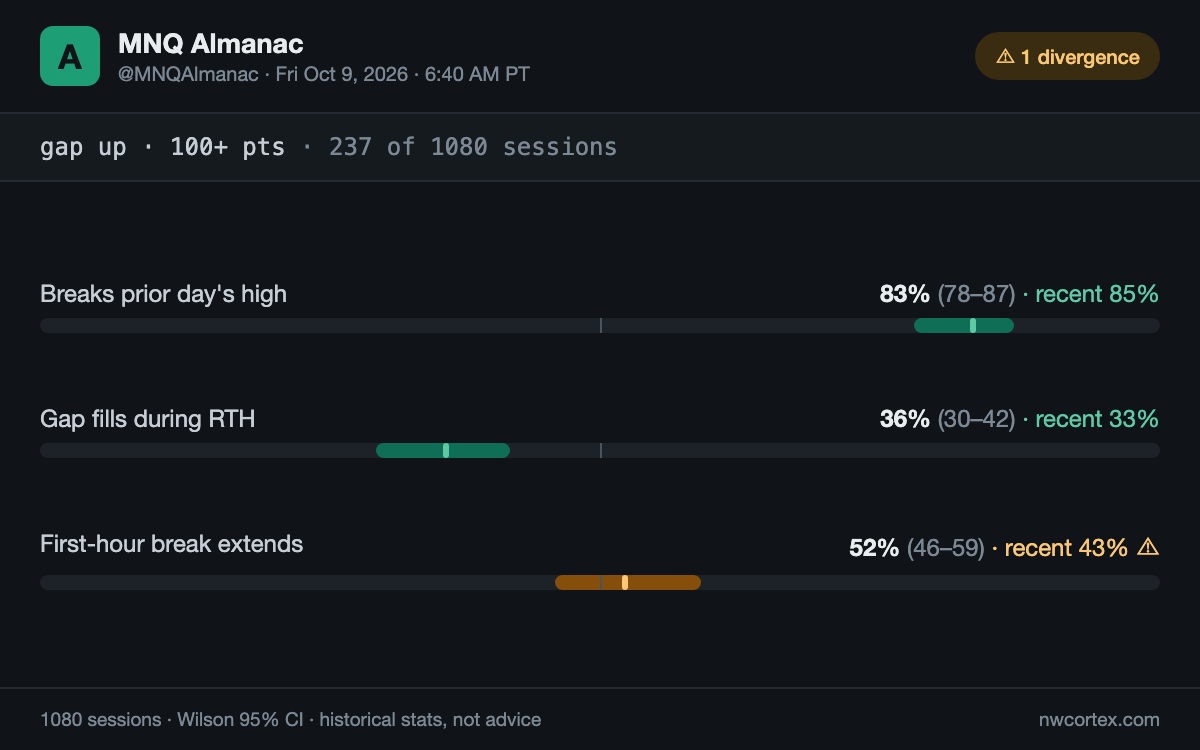
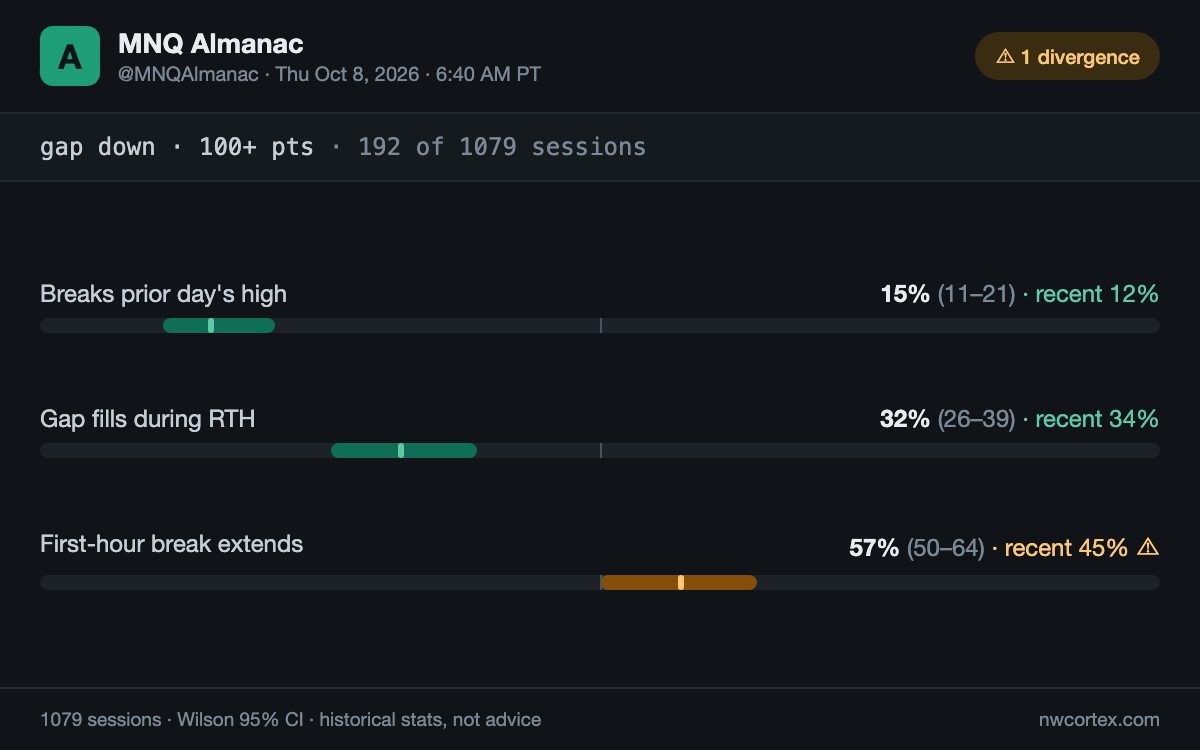
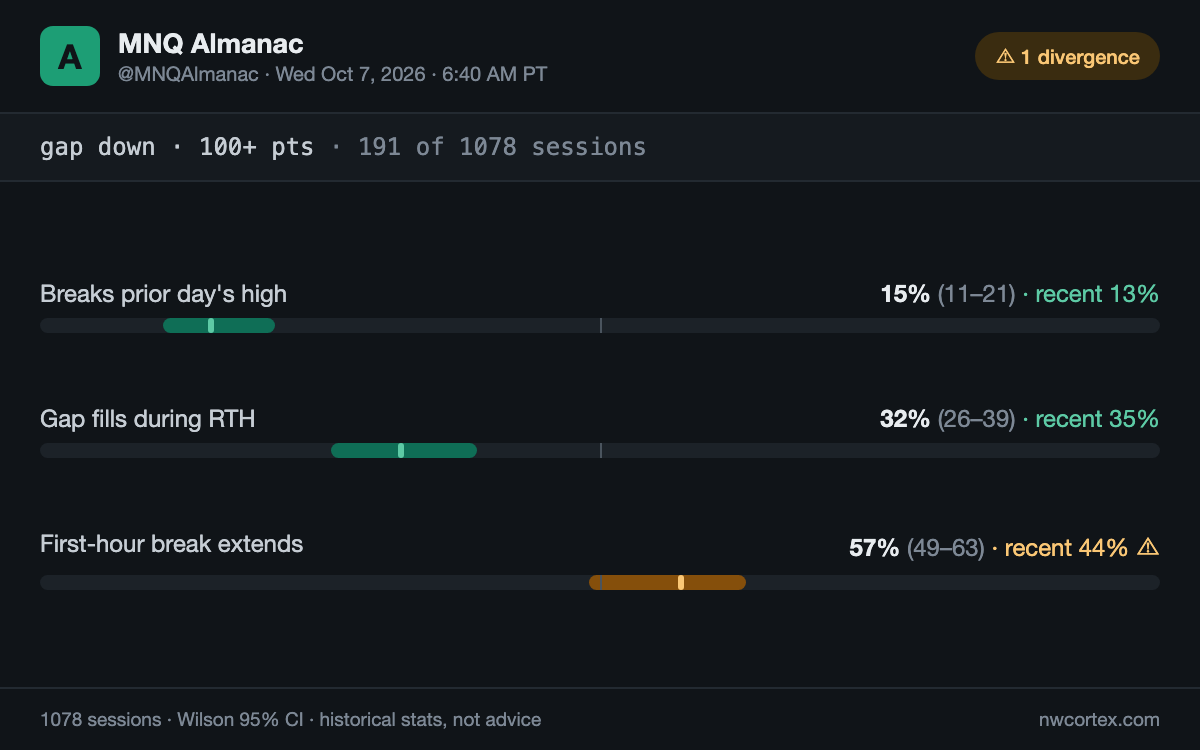
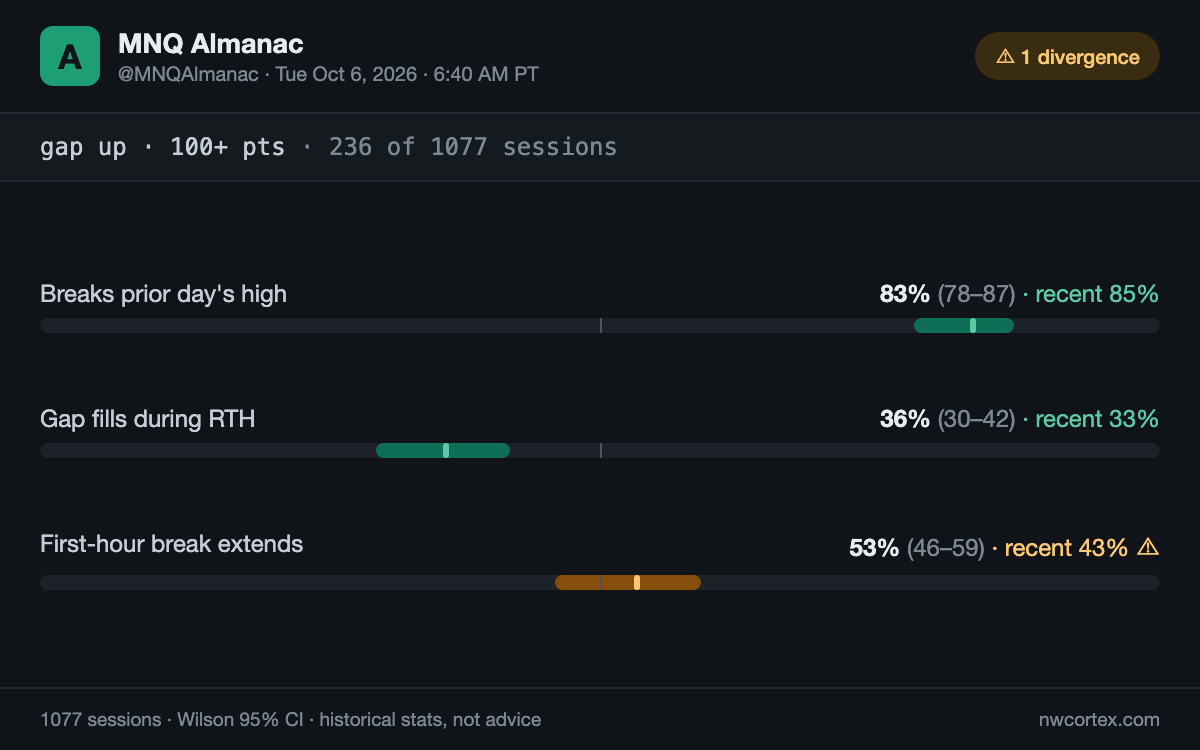
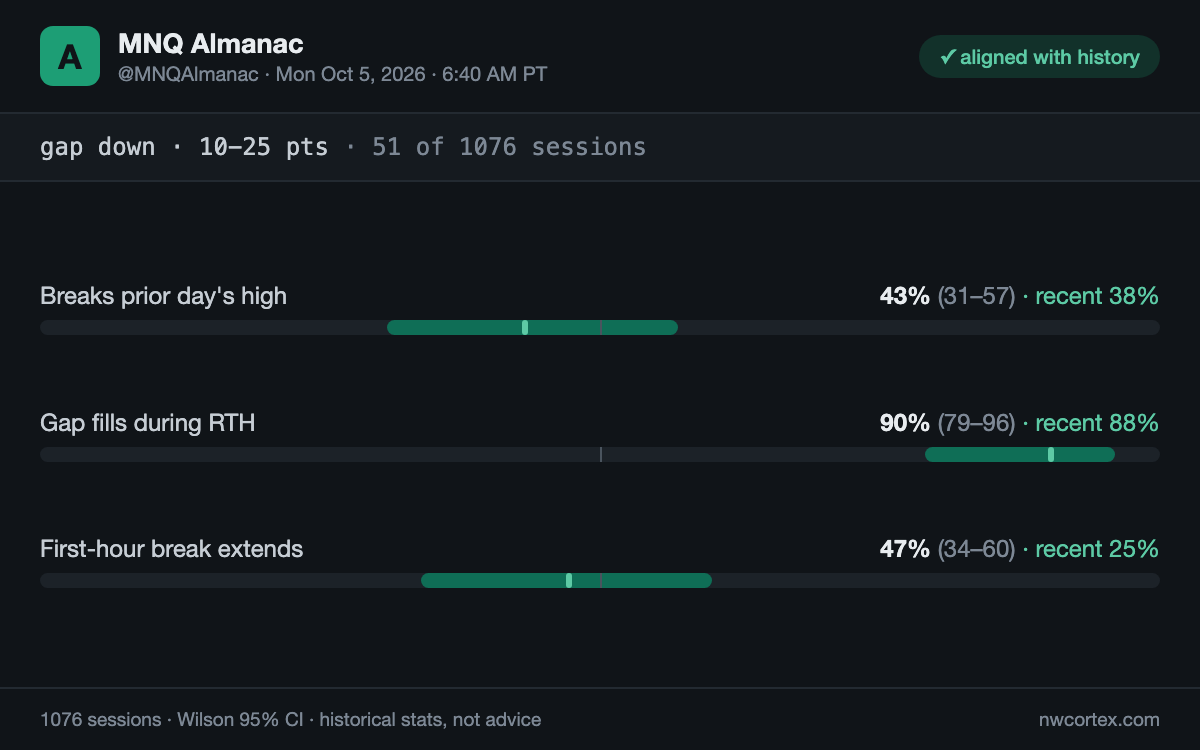
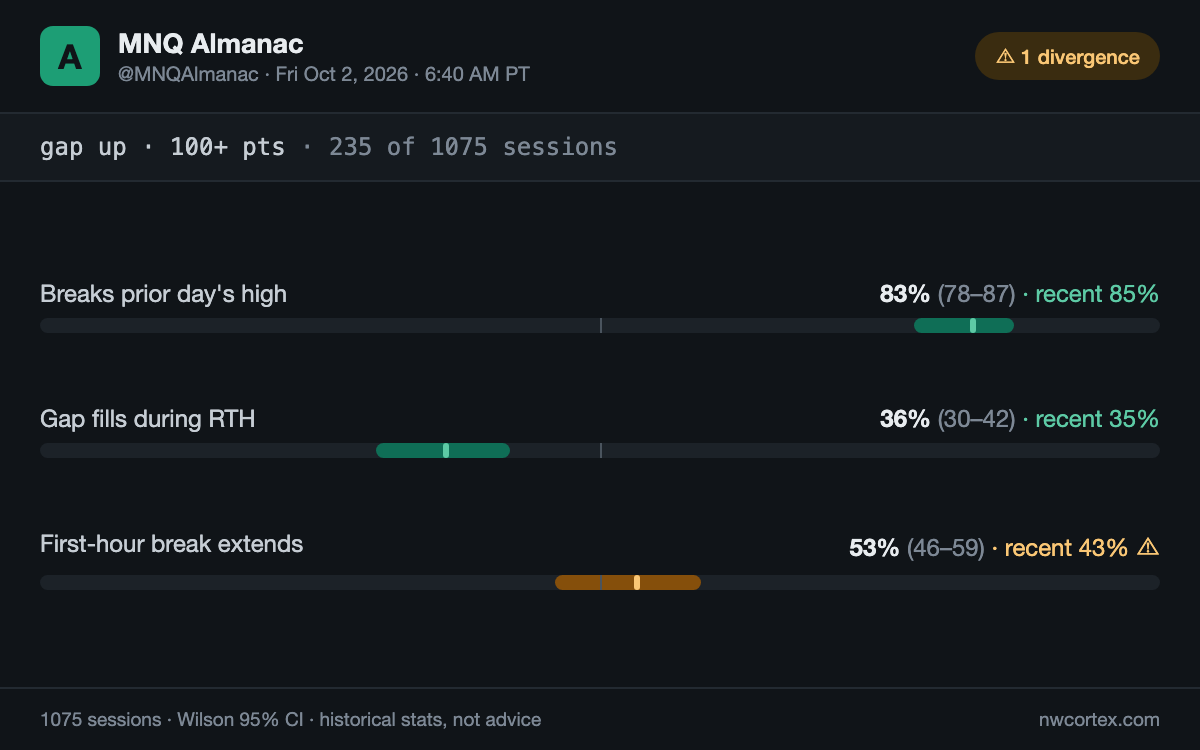
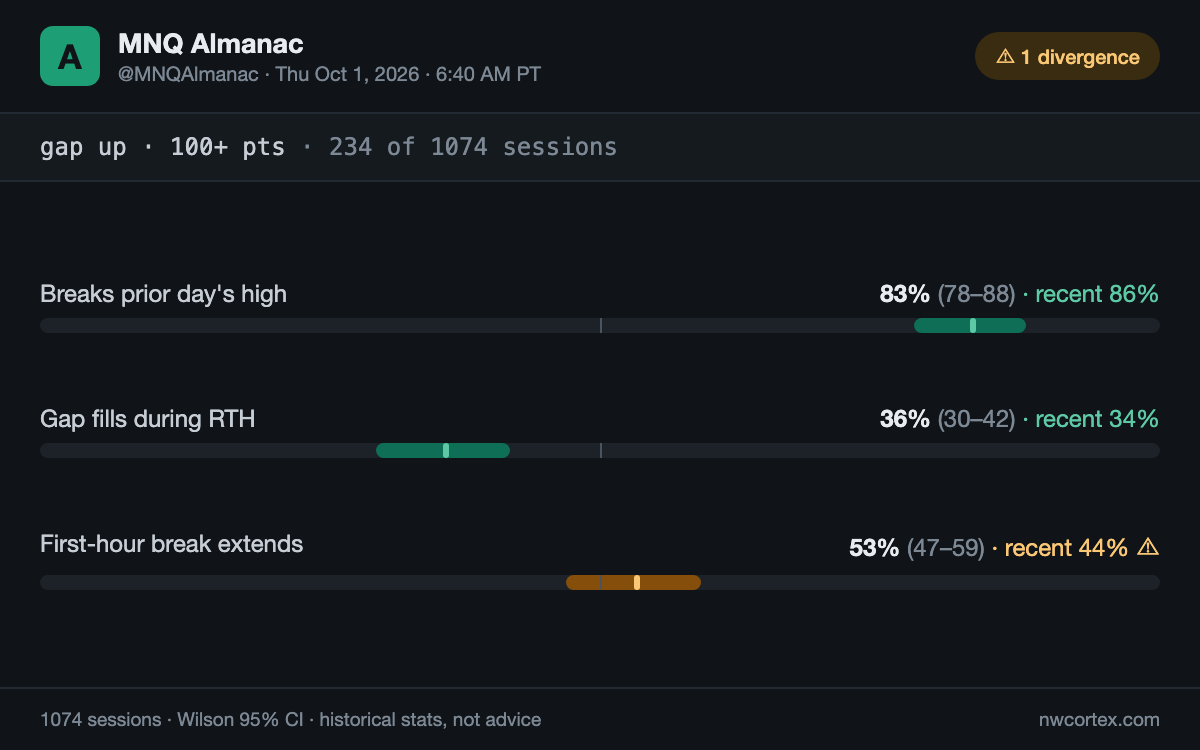
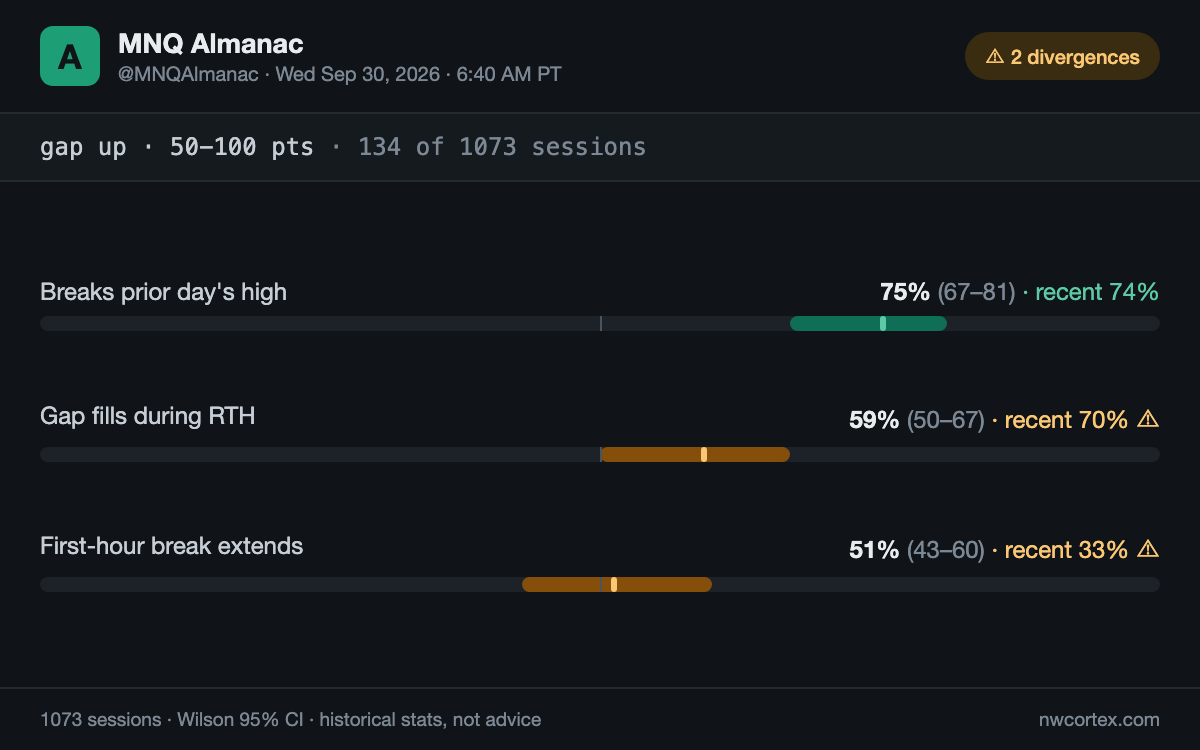
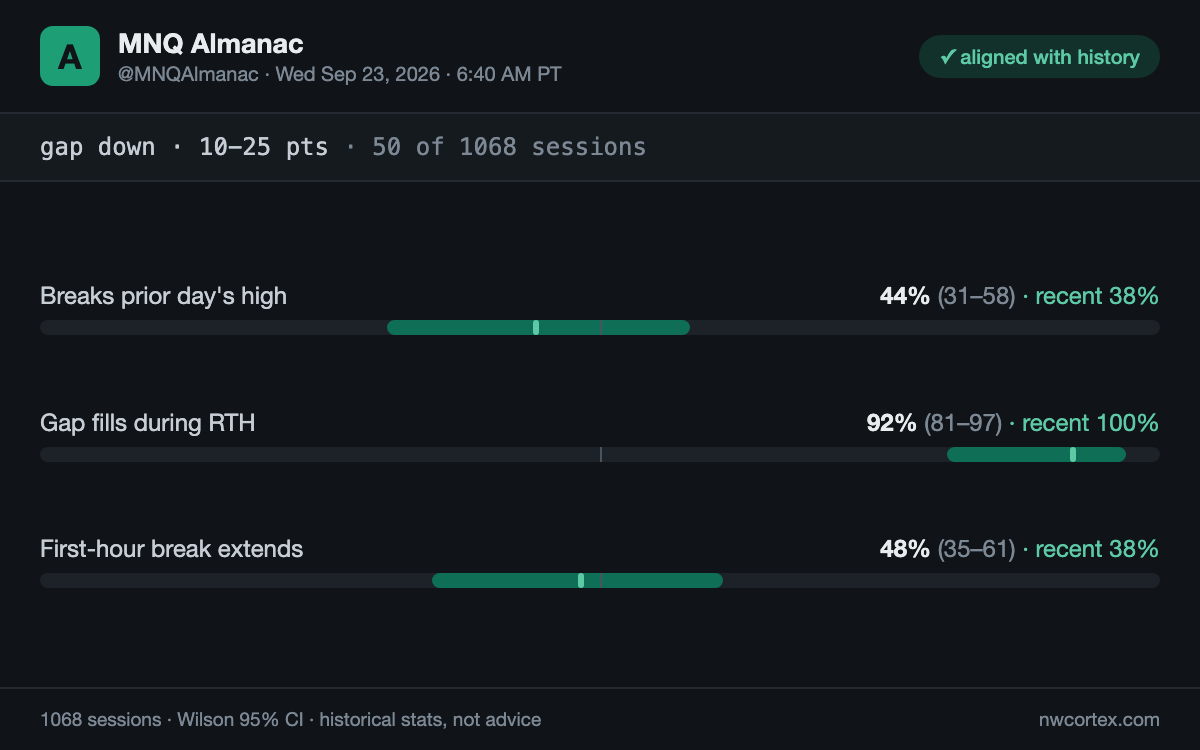
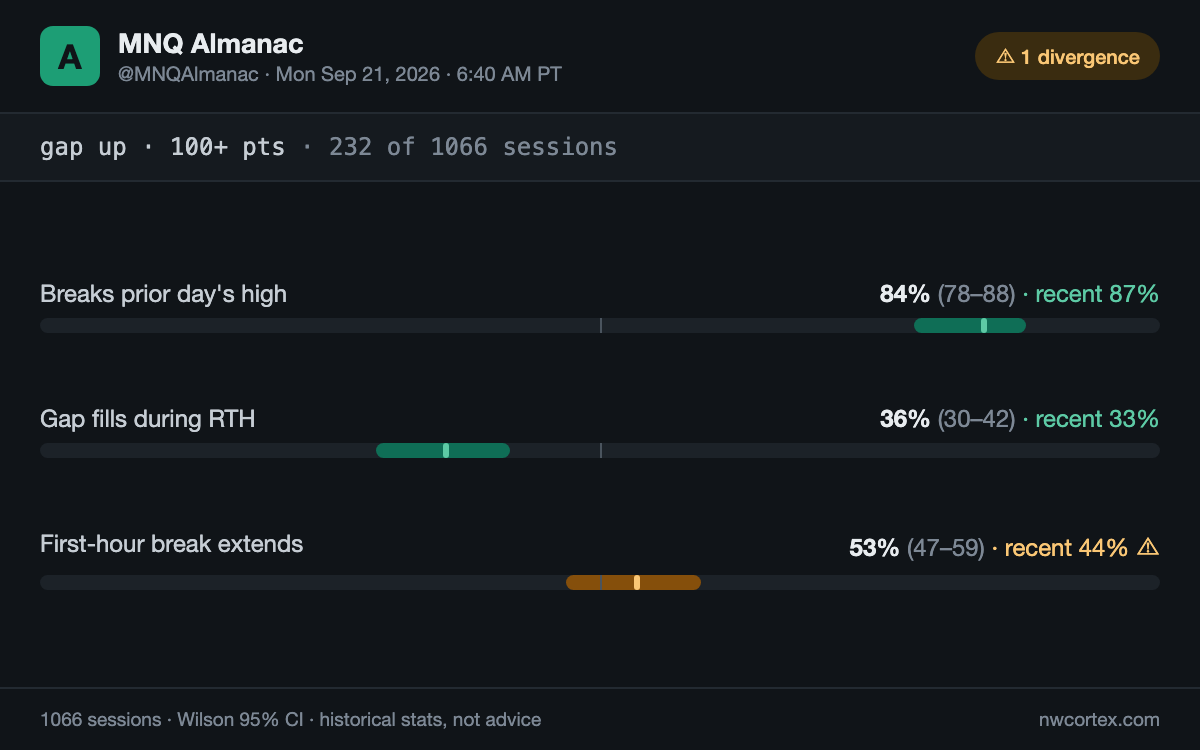
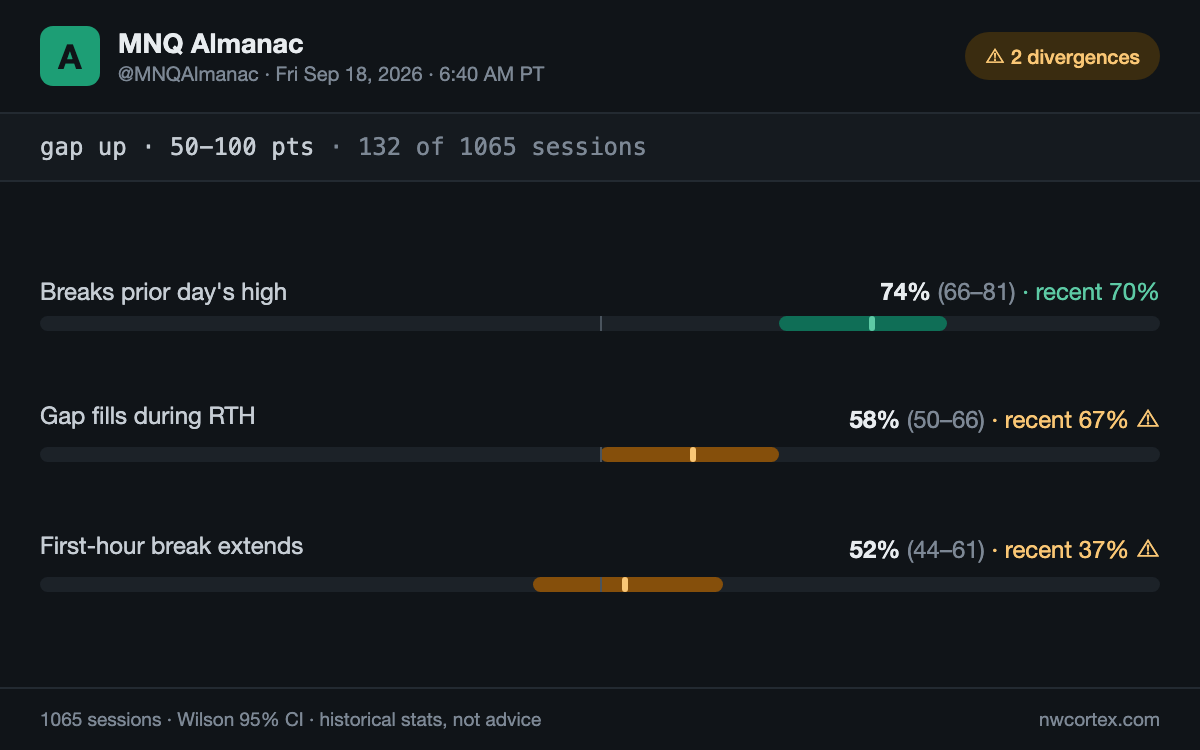
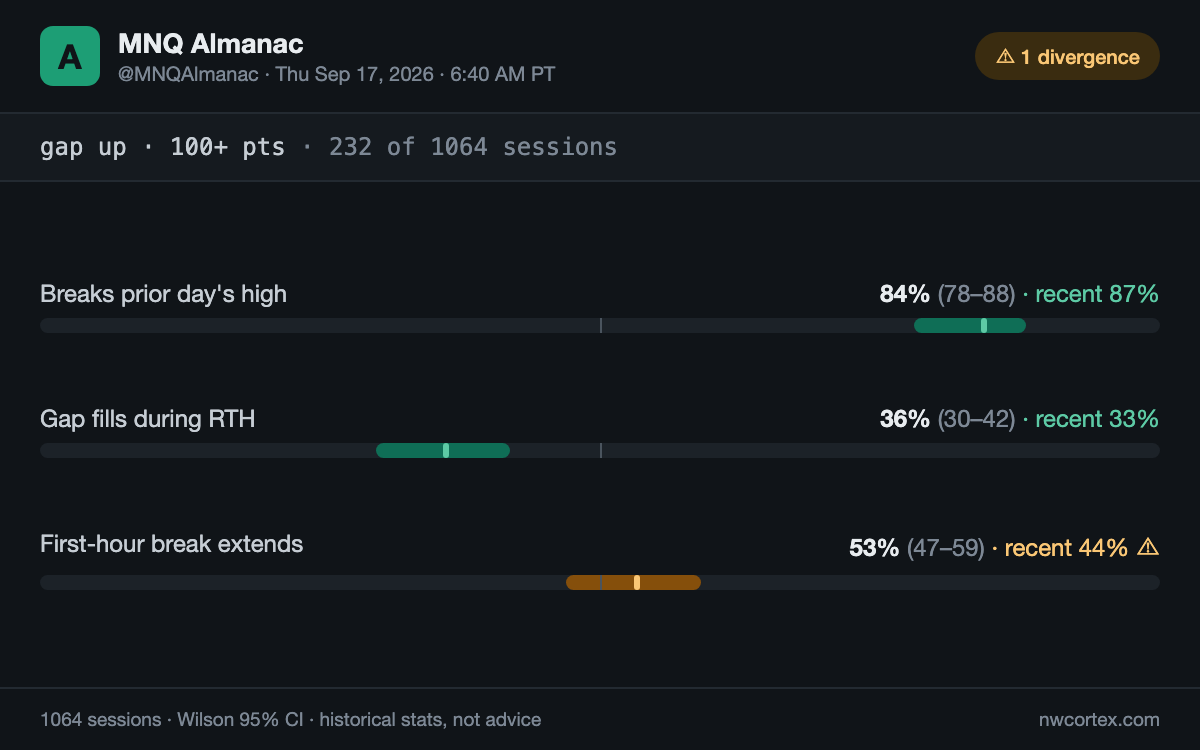
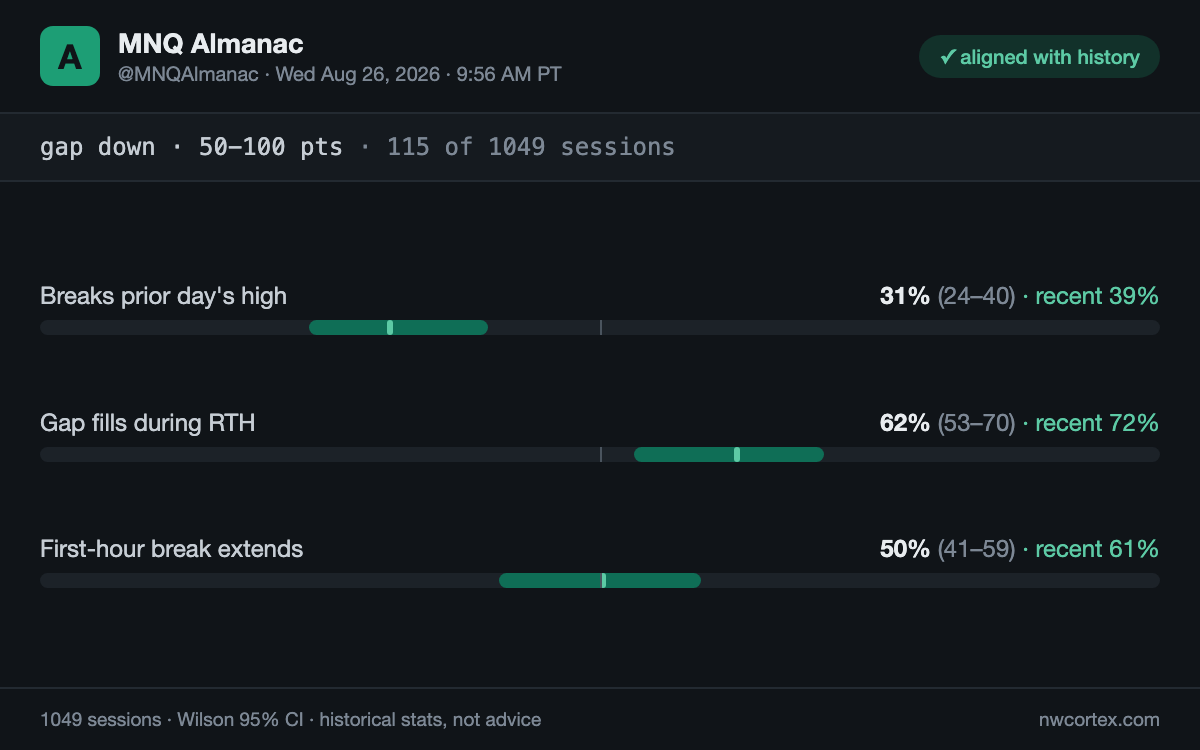
The most recent card is below, labeled with the morning it was published. Weekends, holidays, and circuit-breaker holds get no card — an old card is never relabeled as today's.
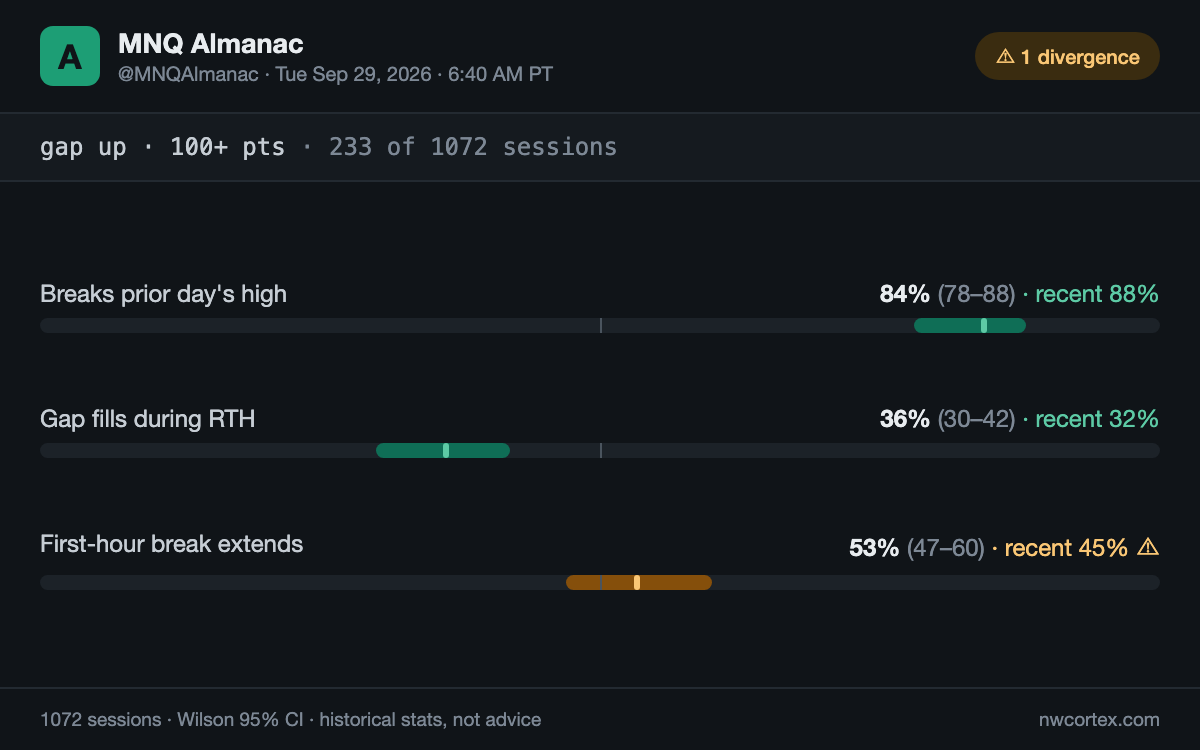
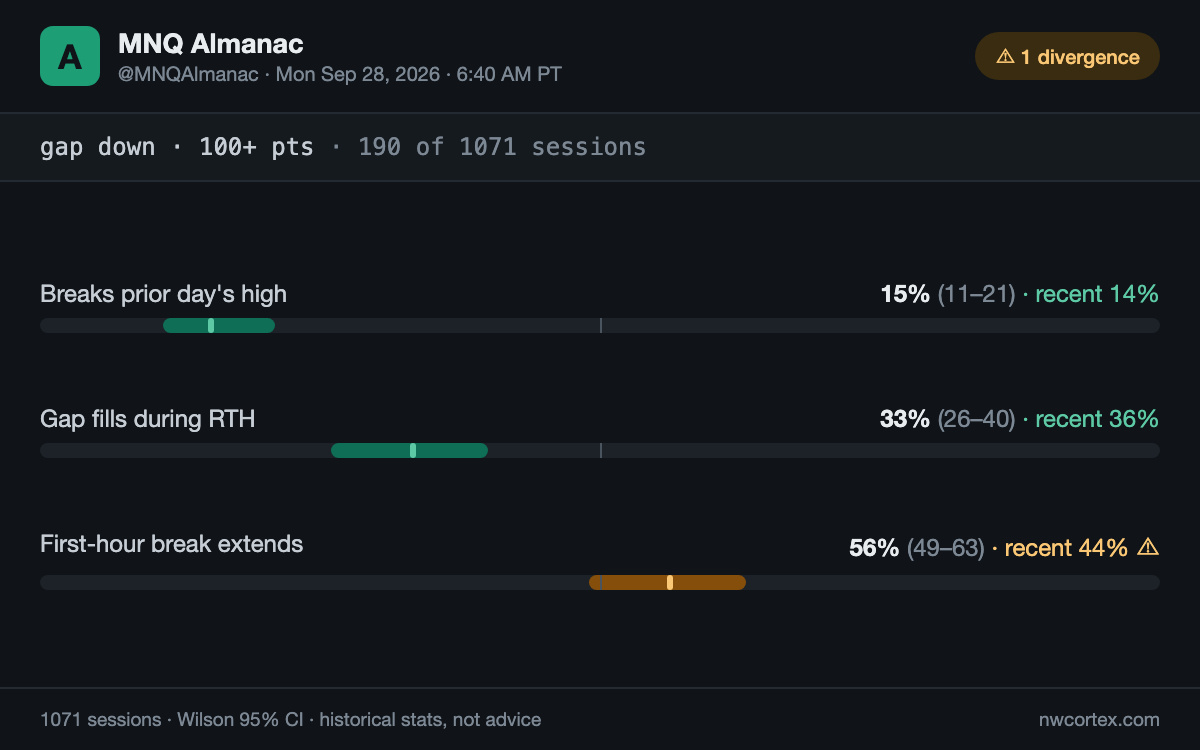
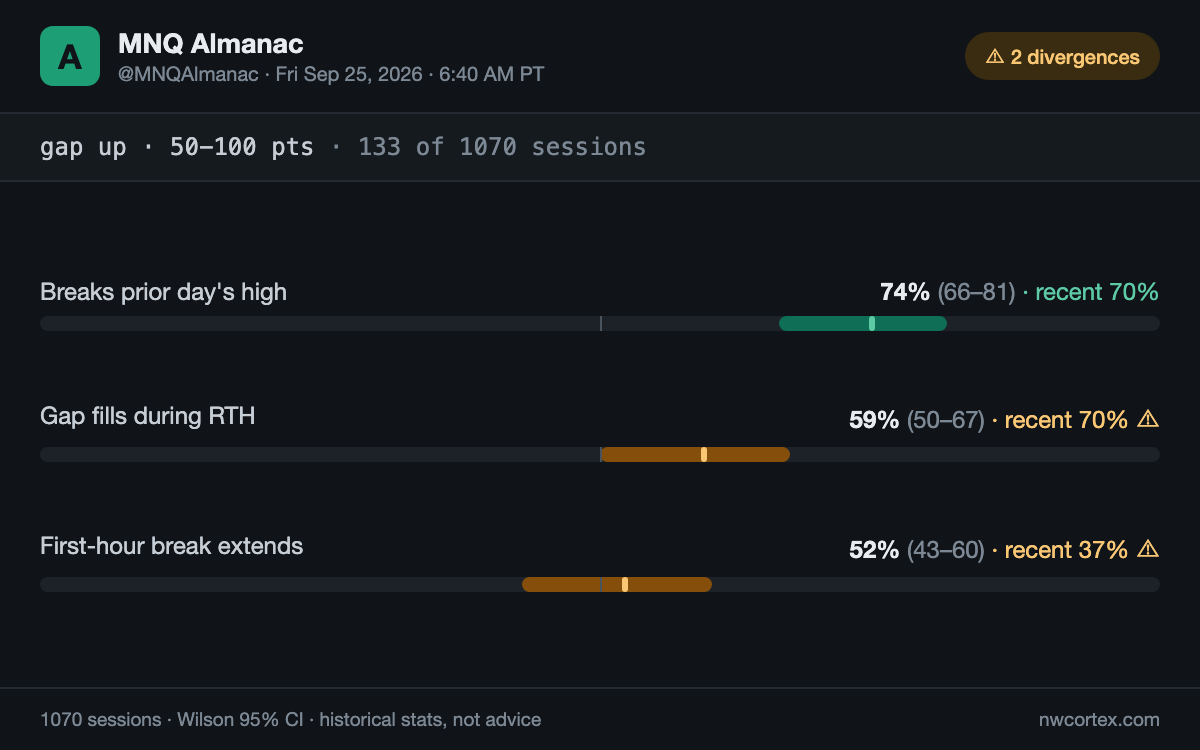
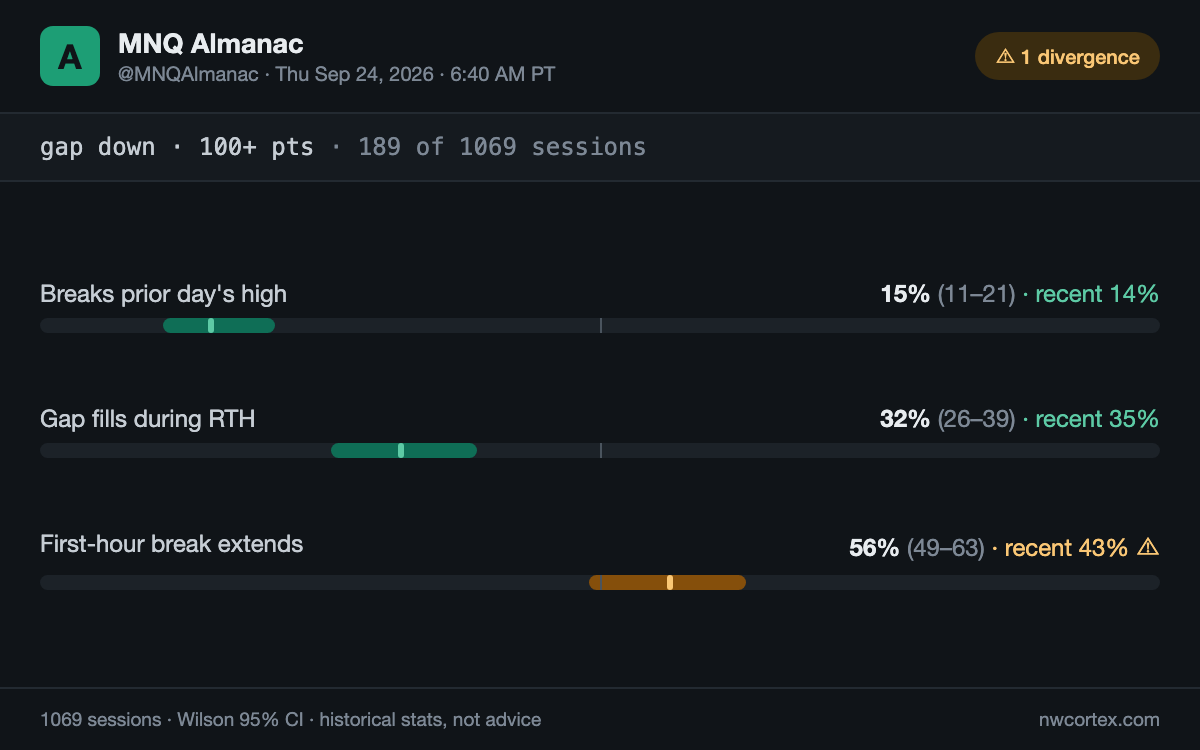
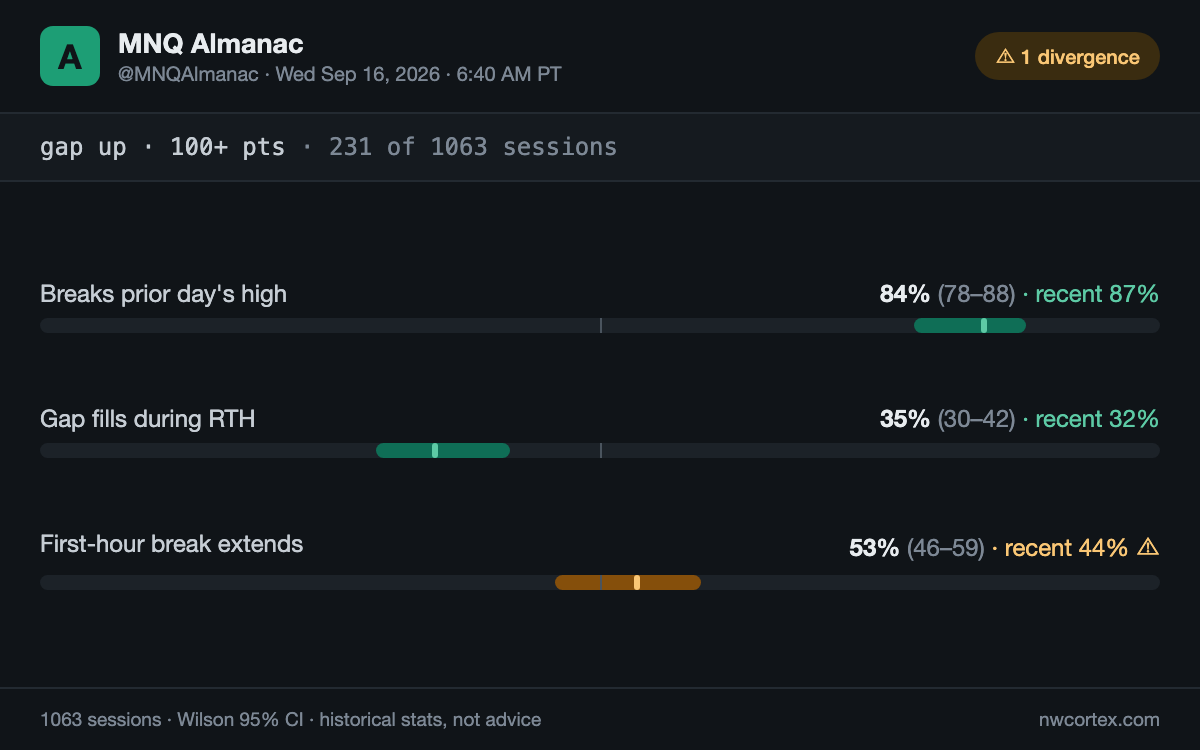
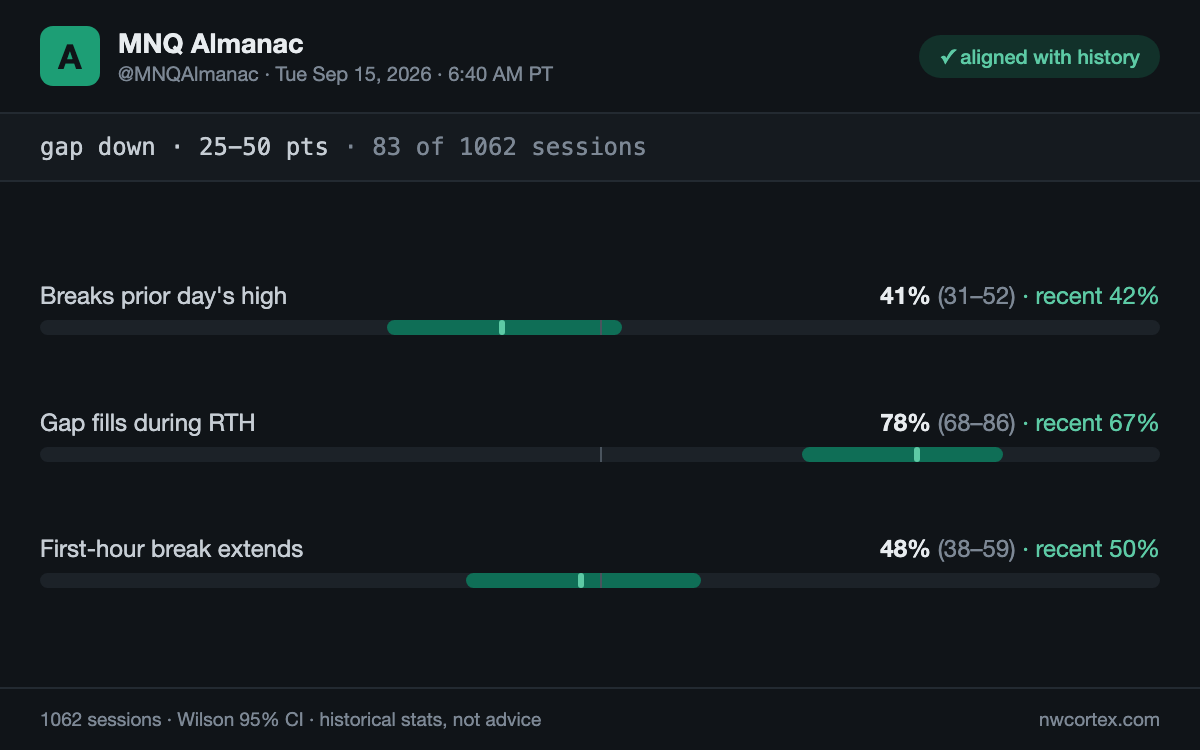
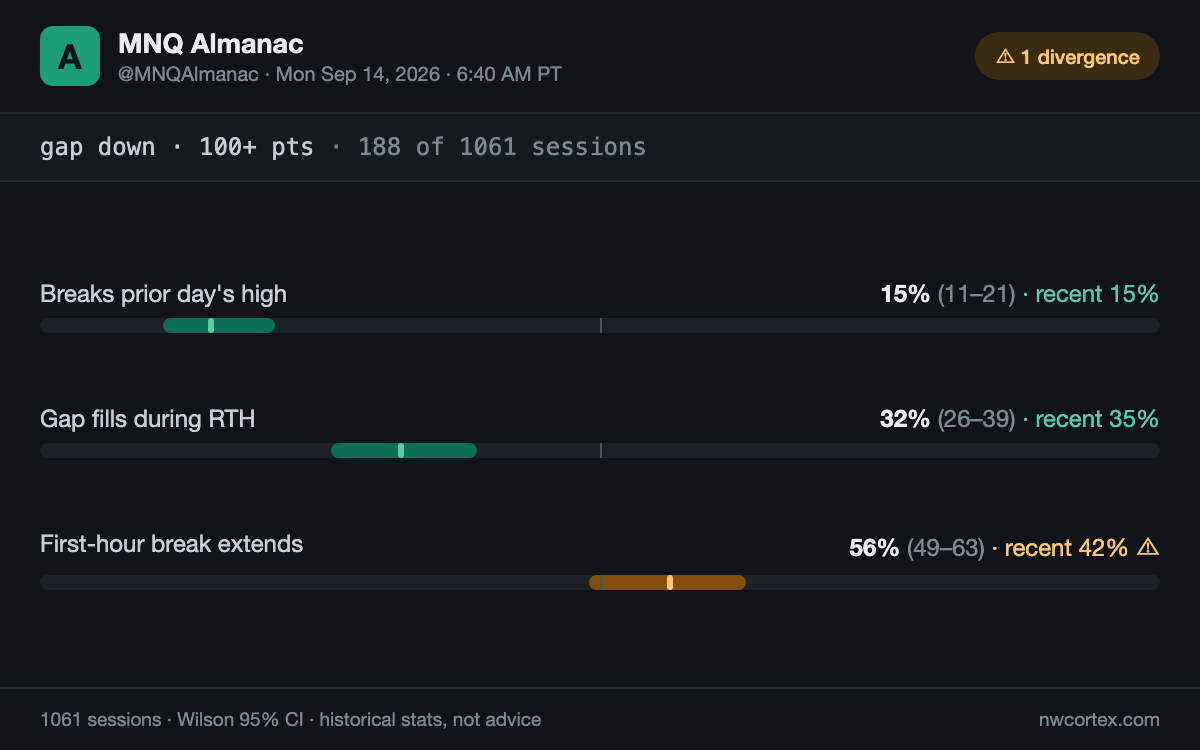
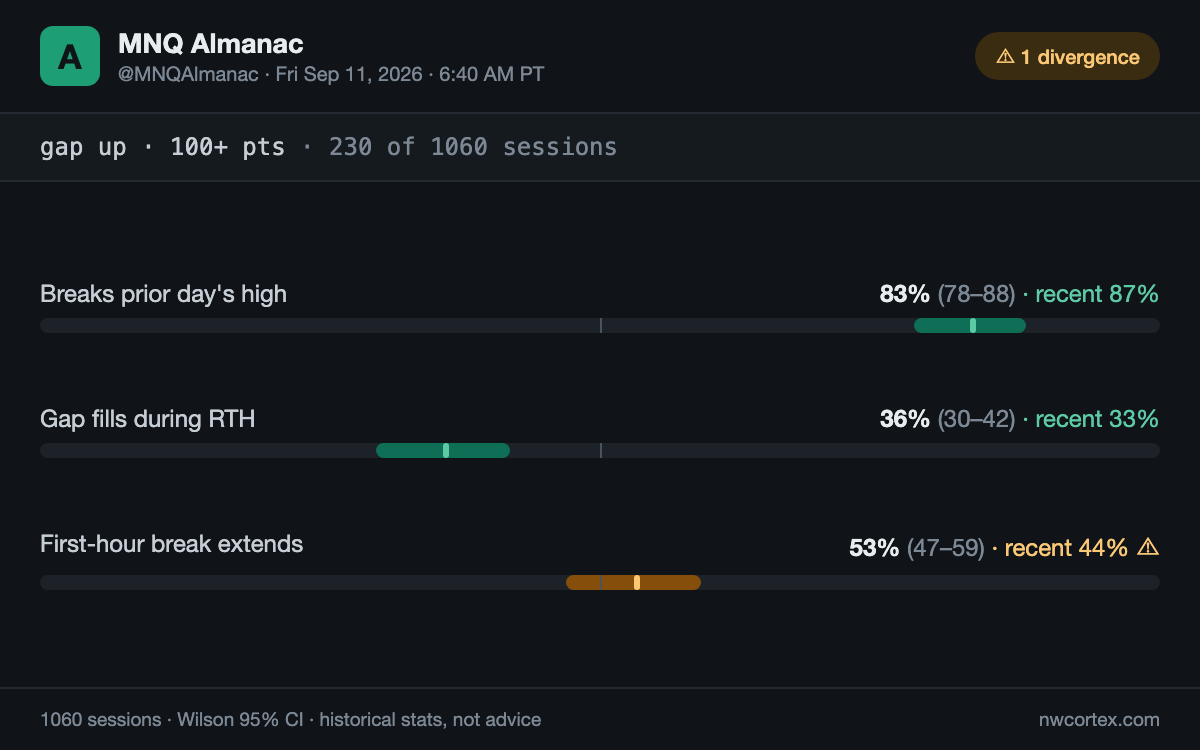
An honest bar, not a prediction
Each row of the card is one statistic about sessions like today's. Here's exactly what the pieces mean.
Each bar is a 95% confidence interval (Wilson), not a prediction. The shaded band is the honest uncertainty around the historical rate. Wide band = small sample, less certainty.
The bright tick inside the band is the historical rate itself — how often this outcome occurred across all matched sessions.
The thin center line is 50% — a coin flip. If the whole band sits to one side of it, history leans that way. If the band straddles it, history is telling you it doesn't know.
"Recent" compares the last 250 sessions against full history. When they disagree, the row turns amber and the card says so. We flag when our own stats look unstable — that's the point.
The header shows how many past sessions matched today's condition. Small samples get wide bars or get dropped entirely — if we can't say something honest, we say nothing.
No trade calls. No entries, exits, or targets. No DMs, ever — anyone DMing you from a similar handle is a scammer. Historical statistics, not advice.
Sealed before tested. Published either way.
Occasionally we test a trading hypothesis properly: pre-registered, then evaluated out-of-sample. The registration is hashed and posted before testing. Failed hypotheses get published in full. Survivors get a topline only. Most ideas fail; you'll see those too.
The full test plan — hypothesis, data range, gates — is frozen as a document before any test runs.
The document's SHA-256 hash is posted publicly. The post's timestamp is the seal date. The document itself stays sealed.
The hypothesis is evaluated out-of-sample, against the pre-registered gates. No moving the goalposts — any edit to the document breaks the hash.
The verdict and the sealed document are published — pass or fail. Verify yourself: sha256sum the document and compare.
| SEAL DATE | ID | SHA-256 | STATUS | LINKS |
|---|---|---|---|---|
| No public seals yet. The first pre-registration will appear here the day its hash is posted — and its verdict will follow, pass or fail. We don't fake entries, which is rather the point of the whole mechanism. | ||||
Almanac updates by email
Occasional email when something worth knowing happens — a lab seal or verdict, a new statistic on the card, a change to how the Almanac works. No trading advice, no promotions, and your address is never shared. Unsubscribe by replying "stop" to any email.
STORED ON OUR OWN INFRASTRUCTURE. USED FOR THE ALMANAC ONLY.